The Qur'an. A deeper understanding.
Make space for reflection with accessible summaries of Al-Mīzān, enriched by narrations from the Ahlul Bayt (a.s.). The whole Qur'an, ready to explore on your phone — free, and working entirely offline.
Please stand by for an updated version.
Check back soon, or leave your email for a release notification.
Free. No account. Works offline.
Beyond the translation
Move from the setting of a verse to its meaning, the narrations connected to it, and the themes it invites you to reflect on.
The Arabic is the Tanzil Uthmani text and the English is Ali Quli Qara’i’s translation, both used verbatim.
Context
Every verse opens on where and why it was revealed, and on what surrounds it. The circumstances first, so the commentary has somewhere to land.
Context
This verse, universally known as Āyat al-Kursī (the Verse of the Throne), appears in Surah al-Baqarah, the longest chapter of the Quran, which was revealed in Madinah and addressed the early Muslim community alongside the People of the Book.
Allāmah Ṭabāṭabāʾī considers this verse extraordinary because it is not simply a list of God's attributes but a deeply unified and logically connected portrait of divine reality — every phrase flows from the one bef…
Tafsīr
Follow the verse phrase by phrase through an accessible summary of Ṭabāṭabāʾī's analysis — twenty volumes of Arabic scholarship, opened up one passage at a time.
Ṭabāṭabāʾī’s analysis
ٱللَّهُ لَآ إِلَٰهَ إِلَّا هُوَ ٱلْحَىُّ ٱلْقَيُّومُ
This opening declaration is the most important theological statement in Islam. God alone is truly alive — al-Ḥayy — meaning His existence depends on nothing, and He is the source from which all other existence flows.
Ahlul Bayt narrations
Narrations drawn from two sources and no others — Nahjul Balāgha and al-Kāfī — with the source and the chain of transmission shown where it is known.
Narration
Imam Ali (a.s.) said: "I cannot understand how a person who has accepted Islam and whose mind is sound could go to sleep at night without reciting Āyat al-Kursī, for it is the treasure of all good things.
Imam Ali ibn Abi Talib (a.s.)Nahjul Balagha
Themes & insights
What the verse is doing beyond the line itself — the ideas running through it, drawn out and numbered so a long passage stays followable.
Themes in this verse
Root words
The Arabic beneath the translation: each root with its meaning, and every other verse in the Qur'an where it appears. Search runs across verses, narrations and themes alike — and in Arabic as well as English, with or without the diacritics.
Roots beneath the words
Free, and completely offline
The Qur'an, the summaries, the narrations and the root-word index all ship inside the app. There is no purchase, no subscription and no advertising — and once it is installed, the network is optional.
On a plane, on the underground, in a basement masjid with no signal. Reading never stops to wait for a connection.
Nothing streams and nothing downloads as you read, which matters wherever data is metered or expensive.
Verses, search results and commentary come from the device itself. No spinners, no waiting, no failed requests.
There is nothing to send, so nothing is logged. No account, no analytics, no tracking. What you read stays on your phone.
No server to go down, no subscription to lapse. The text is yours for as long as the app is installed.
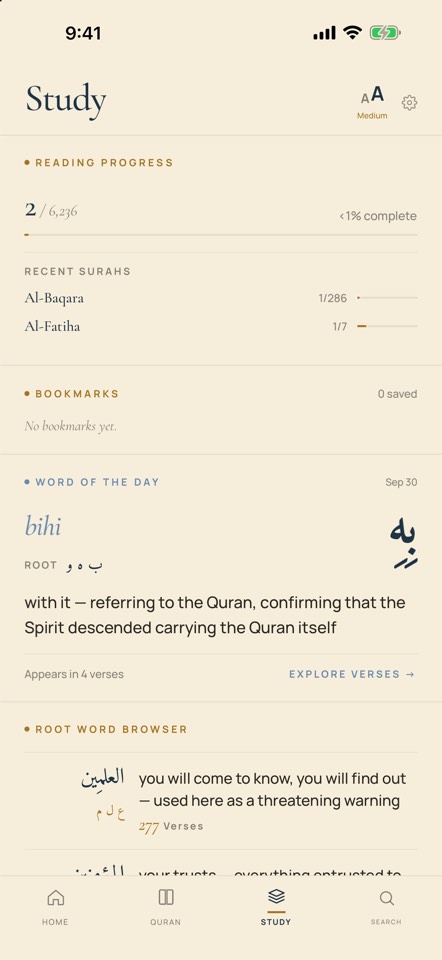
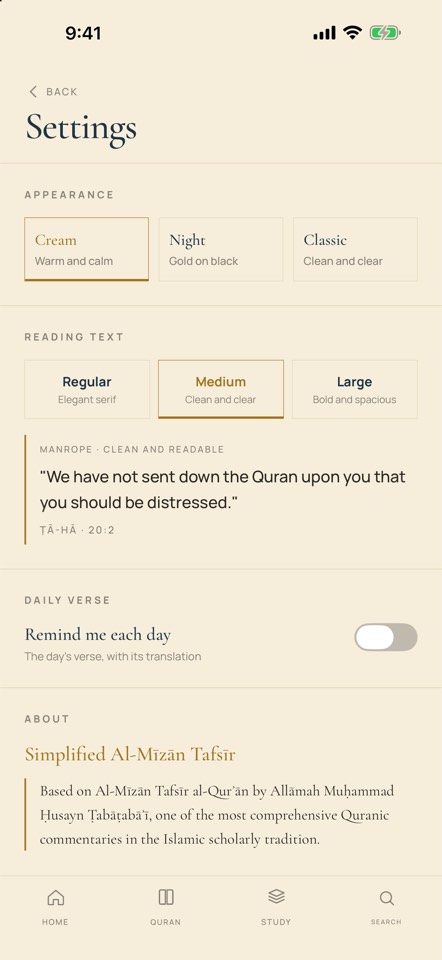
Bookmarks, reading progress, a word of the day and an optional daily verse reminder — three themes and three text sizes.
A rhythm of your own
A few quiet minutes or a longer study session. Keep your place, follow your curiosity, and return when you are ready.
Study
A word of the day with its root and the verses it appears in, the roots that recur most across the Qur'an, and two short quizzes — Makkah or Madinah, and guess the surah from its verses.
Short enough for a spare minute, and a different way of getting the vocabulary to stick.

Search & go to verse
Type a chapter and verse number and go — 2:255 is two taps away from anywhere in the app. Full-text search runs across the verses, the narrations and the themes together — in English, or in Arabic typed bare, without the diacritics.
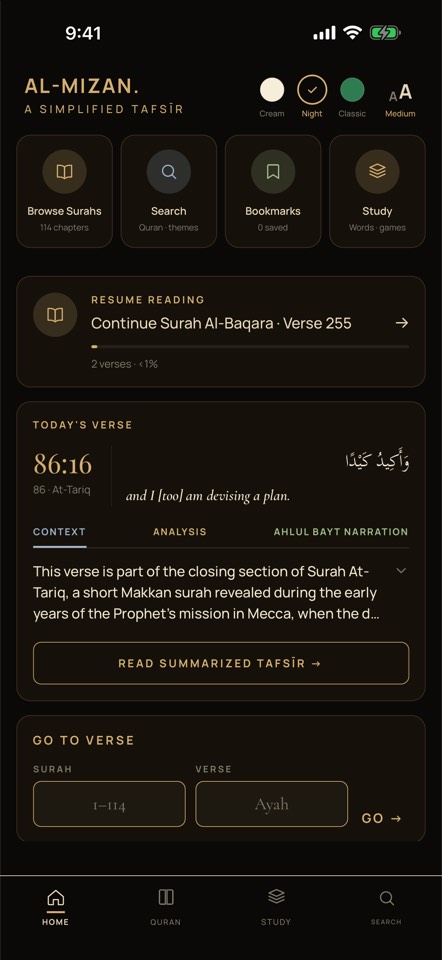
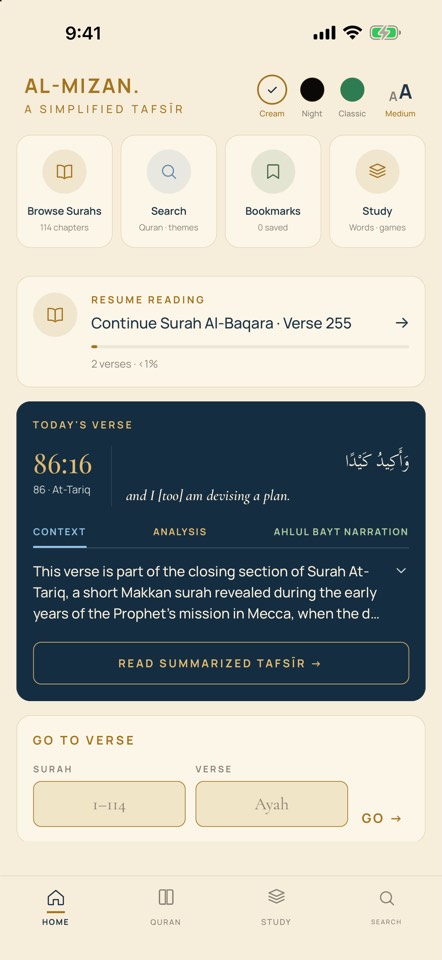
The home screen also resumes your reading and offers a verse for the day with its context already open.
Go to verse
38 results for “justice”
Themes & text size
Three reading themes — cream for daylight, night for late reading, and a high-contrast classic — each at three text sizes, changed from the header or from Settings.
Translations of the Qur'an deliberately stay one size and one style throughout, so a verse reads the same wherever you meet it while everything around it scales.
Save any verse and find it again from the home screen. The list lives on your device and syncs nowhere.
The app remembers the last verse you opened and how much of the Qur'an you have read, and offers to pick up from there.
Optional, at an hour you choose. Your phone schedules it itself, so it arrives with no signal and nothing is sent to a server.
Our approach
Al-Mīzān is a work of depth and detail — twenty volumes written in Arabic over some two decades, and one that few readers ever get through in full. This app offers a more accessible way to begin engaging with its commentary, one verse at a time. It is a door into the work, not a replacement for it.
The Qur’an text and the translation are not AI-generated. The Arabic is the Tanzil Uthmani text and the English is Ali Quli Qara’i’s translation, both used verbatim from the Tanzil Project and credited in full inside the app.
The commentary summaries are AI-assisted. They were prepared with AI assistance, guided by carefully written prompts, from Ṭabāṭabāʾī’s original work. Every effort has been made to represent the tafsīr faithfully, but an AI-assisted summary cannot carry the full depth and rigour of the original, and it may contain errors or miss important nuance. Readers are encouraged to consult the complete text. If a passage seems inaccurate, the Flag button on any verse sends us the reference along with your comments. Those reports are read, and they are how the text improves.
The man, and the work
Twenty volumes of Arabic, written over two decades, by a man who spent ten years farming before he ever taught in Qom.
He was born in Tabriz in 1903, into a Sayyid family of scholars, and orphaned early — his mother when he was five, his father when he was nine. After studying in Tabriz he went to Najaf for ten years, reading jurisprudence under Mīrzā Muḥammad Ḥusayn Nā’īnī and Muḥammad Ḥusayn al-Ghawī al-Iṣfahānī, philosophy under Sayyid Ḥusayn Bādkūbā’ī, and — under Sayyid ‘Alī Qāḍī Ṭabāṭabā’ī — the disciplines of the inner life that shaped everything he wrote afterwards.
Then money ran out. He returned to the family village of Shādābād near Tabriz and spent roughly ten years farming, restoring the irrigation channels and the orchards. It is an unusual decade to find in the life of a man later called the most significant Shia thinker of his century, and those who knew him wrote more often about his humility than his learning.
He moved to Qom in 1946 and began teaching philosophy and Qur’anic exegesis at a time when both sat at the margins of the seminary curriculum. In doing so he changed what a generation studied: Murtaḍā Muṭahharī, Ḥasanzādeh Āmulī, Mūsā al-Ṣadr and Seyyed Hossein Nasr were among those who sat with him. He held long philosophical exchanges with the French scholar Henry Corbin, and besides Al-Mīzān he wrote Bidāyat al-Ḥikma, Nihāyat al-Ḥikma, and the Principles of Philosophy and the Method of Realism. He died in Qom on 15 November 1981.
He began it after reaching Qom and finished it on Laylat al-Qadr, the 23rd of Ramaḍān 1392 — 31 October 1972. Roughly two decades of work, and about eight thousand pages across twenty volumes of Arabic.
Its method is what sets it apart: tafsīr al-Qur’ān bi’l-Qur’ān, interpreting the Qur’an through the Qur’an itself, letting verses illuminate one another before reaching for anything outside the text. Each passage is taken in turn — first an exposition of the verses and their language, then a separate section gathering the narrations that bear on them, and frequently a further discussion, philosophical, historical, social or scientific, where the subject calls for it. The result is less a running gloss than a sustained argument about how the Qur’an coheres.
“His Tafsīr al-Mīzān may be one of the best exegeses of the Qur’an… I dare claim that the exegesis is, in certain respects, the best exegesis written among Shiites and Sunnis from early Islam until today.”
Murtaḍā MuṭahharīHis student, and among the foremost Shia thinkers of the twentieth century
“This is a work on the basis of the great method of interpreting the Qur’an by the Qur’an, and it definitely contains truths that have so far been hidden from us.”
Nāṣir Makārim ShīrāzīMarja’ and Qur’anic exegete
“The founder of a particular style in Qur’anic exegesis — the disambiguation of a Qur’anic verse by an appeal to other verses.”
Ja‘far SubḥānīOn what Ṭabāṭabā’ī established
Assessments as rendered in English by WikiShia.
More from Azadar777
Azadar777 builds free, offline apps in the service of the Ahlul Bayt (a.s.). Al-Mīzān Summarized is the first; this is the second.
A single master line running from the birth of the Prophet (ṣ) to the Occultation of the Mahdī (aj) — more than three centuries in one continuous view, so the shape of the history is visible at a glance.
Beneath it run sub-timelines: the battles, the events that turned the tradition, and — set in parallel — the caliphal dynasties and the world empires of the same years. The point is what the parallels show. Who ruled in Damascus, in Ctesiphon, in Constantinople while a given Imam lived, and what else was happening the year an event took place.